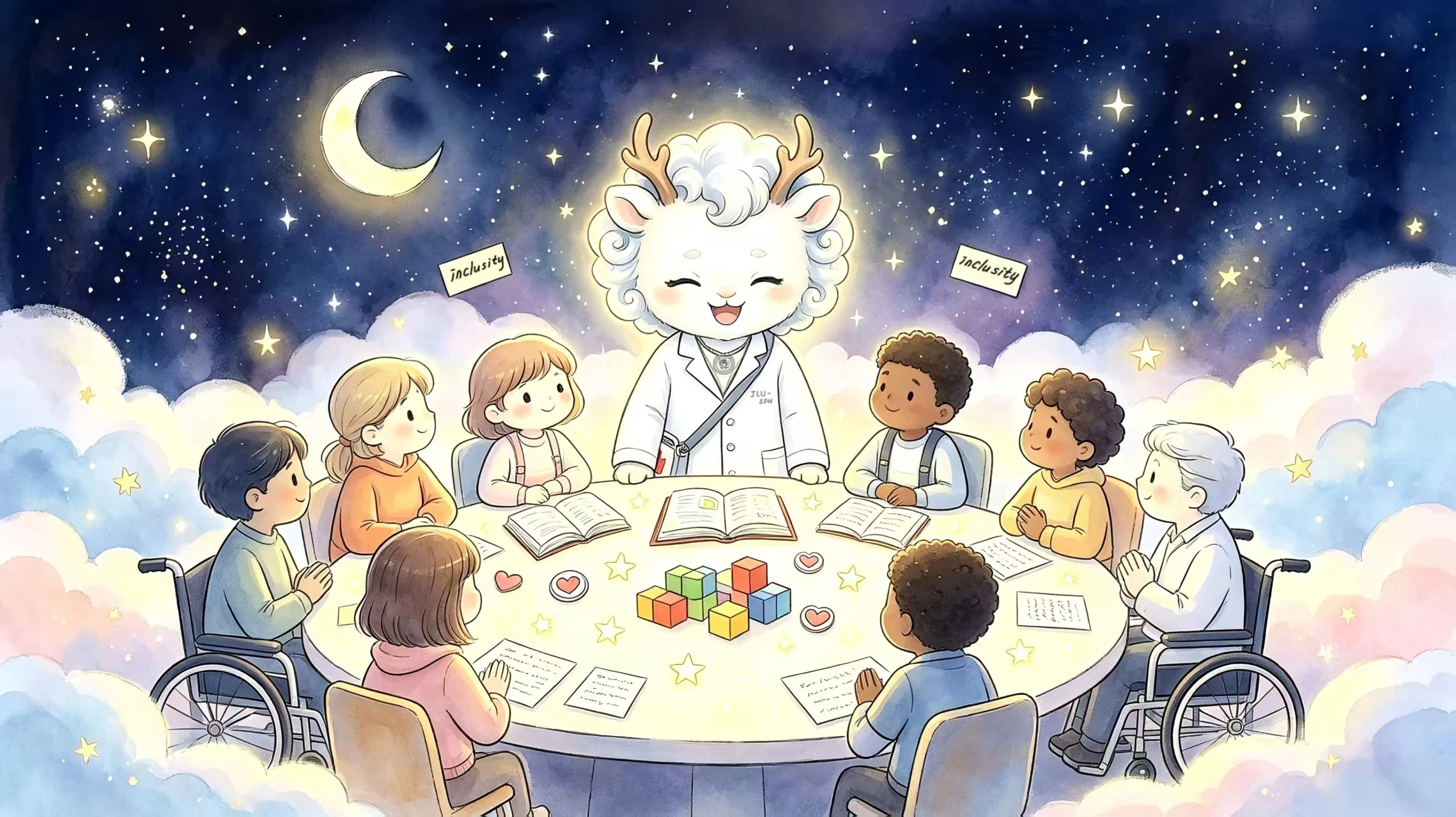
An inclusive learning circle with people of different backgrounds and abilities

JLU-SPH iGEM 2026 · Engagement

Diversity &
Inclusivity

Let the light of synthetic biology warm every curious mind.

Explore

When science meets inclusivity

Innovation gains warmth.

In the world of synthetic biology, we are not only engineers exploring the code of life, but also gardeners sowing the seeds of science. We firmly believe that the appeal of this discipline should not be confined within laboratory walls. It should travel across mountains and rivers, break through barriers of understanding, and reach every mind eager for knowledge in the warmest possible way.

Inspired by the spirit of iGEM, our journey is one of reverence and creativity: transforming the precise logic of life science into a universal language that resonates with people of different life experiences.

Concept map of an inclusive biology project
One discipline, many ways to encounter it.
01

Across age

Wonderful Building Blocks of Life

Exploring synthetic biology with kindergarten children

Background

At the age when children are most curious, an introduction to science can feel like a game. We believe that the seeds of synthetic biology can be planted as early as kindergarten—allowing children to touch with their own hands and observe with their young eyes, turning the mysteries of life into intuitive and enjoyable experiences. All activities were conducted under professional guidance and in strict accordance with safety standards.

Audience

Kindergarten students and preschool children aged 4–6.

Objectives

  • Introduce the idea that life is made of tiny parts and can be designed through simplified, game-based activities.
  • Develop curiosity, observation, and hands-on skills while ensuring absolute safety.
  • Offer teachers and parents a practical model for early-childhood science education.

Process · Little Cell Engineers

  1. Storytelling: a cell became a “little factory” whose organelle machines work together.
  2. DNA craft: children used certified child-safe clay to build a double helix and take home a “ladder of life.”
  3. RNA role-play: children carried colored “codes” from nucleus to ribosome through movement and teamwork.
What we learned

“This is the ladder of life I made!” Young children can understand synthetic biology when it is presented in their own language and logic. Safety is the non-negotiable foundation of outreach for children, and rigor and creativity can go hand in hand.

02

Across distance

Beyond Mountains and Seas

Sowing scientific dreams with students in county-level communities

Background

Across the Central Plains and the mountains of Northwest China, countless eyes shine with a desire to explore the world, yet students rarely have opportunities to encounter cutting-edge science. We hoped to be a gentle breeze carrying the seeds of synthetic biology to land full of potential.

Audience

Students in counties and towns across Central, Northeastern, and Northwestern China.

Objective

Broaden scientific horizons, cultivate innovative thinking and problem-solving, and help bridge gaps caused by unequal educational resources.

Process

Our “Life Systems Engineers” course turned gene circuits into creative building blocks and cell factories into a role-played miniature city. Stories from iGEM showed students that young people can be innovators too.

What we learned

A quiet student showed us his sketch of a “future eco-friendly bacterium.” The essence of science communication is not how much knowledge we impart, but whether we ignite an innate curiosity. Even remote places can nurture ideas capable of changing the world.

03

Across generations

Wisdom in Silver Years

Exploring the mysteries of life with older adults

Background

Older adults have witnessed decades of technological change and possess deeply personal perspectives on health, yet can feel distant from rapidly developing technologies. We hoped to make synthetic biology tangible and perceptible, while listening to their health needs.

Audience

Older adults living in nursing homes and students at universities for older adults.

Objective

The right to express one’s needs should never belong only to the majority. Our age-friendly portable testing device shifted the focus toward minority groups around us.

Process

Salon events began with familiar fermentation, then used enlarged tactile DNA and organelle models. Discussions connected respiratory health and biosensors with medical changes participants had witnessed, creating a dialogue between lived experience and new technology.

What we learned

“Science has come so far, yet its purpose is still to help us live healthier lives with greater dignity.” The warmth of science lies not only in advancement, but in the respect and care it extends to every stage of life.

Activity proposalRead the Senior Life Science Interactive Salon plan ↗
04

Across sensory barriers

Sound as a Bridge

Listening to the rhythm of life with people with visual impairments

Background

The appeal of science extends beyond visual presentation. The intricacies of synthetic biology can be conveyed through sound, touch, smell, taste, and imagination.

Audience

People with visual impairments and students in inclusive education interested in life science.

Accessible science handbook

Touch the structure. Hear the system.

With an association for people with visual impairments, we created “Listening to the Cell Factory.” Modular pieces made gene circuits tangible; safe edible materials introduced microbial outputs through smell and taste; and a 56-page handbook in Chinese National Common Braille extended the experience beyond the workshop.

Download the Braille handbook ↓
What we learned

“Words like ‘gene’ used to feel very distant to me—like images under a microscope. But today, I heard their activity and touched their structures.” When science is perceptible in different ways, it becomes a bridge connecting people and minds.

05

Across cultures

A Dialogue Across Continents

Envisioning the future of science with young people around the world

Background

Science knows no borders, and the meeting of different ideas is one of the strongest sparks for innovation. We built cross-cultural bridges to explore synthetic biology together with young people around the world.

Audience

Young students from countries around the world.

Objectives

Promote in-depth exchange, inspire innovation, cultivate a global perspective, and explore how synthetic biology can address shared challenges in culturally relevant ways.

Process

  1. Prepared culturally resonant scientific examples.
  2. Held roundtables on localized innovation.
  3. Formed mixed teams for cross-cultural design challenges.
  4. Presented proposals for questions and suggestions from multiple perspectives.

Korean students shared commercialization insights, British students discussed ethical standards, and Canadian students emphasized cultural inclusivity. Together, participants designed a synthetic biology tool that could help an “alien visitor” understand life on Earth.

What we learned

“I never imagined that a scientific discussion could be so interesting and inclusive.” Synthetic biology is not only a discipline, but a language capable of crossing cultural boundaries and promoting mutual understanding.

06

Across practice and research

Lighting a Spark in the Community

Discussing the scientific frontier with guardians of public health

Background

Frontline healthcare workers safeguard public health every day and possess extensive practical experience, yet are often separated from the frontiers of scientific research.

Audience

Community and rural doctors, CDC staff, and other frontline healthcare workers.

Objective

Build dialogue between researchers and frontline healthcare workers, connect research outcomes with real needs, and bring portable synthetic biology testing closer to frontline public health.

Clinic of Tomorrow

  1. Accessible technology demonstrations.
  2. Comparative analysis of traditional testing and biosensors.
  3. Needs-focused discussion about frontline challenges.
  4. Collaborative planning for deployment and cooperation.
What we learned

“The most ingenious technologies are often born from the most urgent needs.” The most vital innovations arise from sincere dialogue between science and practice.

07

Across gender bias

Her Power

Face to face with women scientists, envisioning the future of synthetic biology

Background

Women researchers expand synthetic biology through distinctive perspectives, persistence, and creativity, yet their stories are often hidden behind paper bylines and laboratory lights. Making their faces and journeys visible is itself an important form of inspiration.

Audience

Young women curious about synthetic biology and life science, especially secondary-school and university students.

01

Build genuine connections

Present the diverse and human growth paths of women researchers so young women can feel: “They are like me, and I can become like them.”

02

Present diverse pathways

Show careers in research, entrepreneurship, policy, and science communication.

03

Inspire active exploration

Turn role-model power into concrete first steps toward literature research, project ideas, iGEM, and partnership.

Seeing Her Power

A WeChat column used “One Question, One World” interviews to present local young women scientists through their choices, setbacks, and passion.

A Day in Research Life

Small salons offered a view into real workplaces, materials, demonstration experiments, and honest questions about how research grows from an idea.

My First Step

A team-led workshop translated aspiration into literature searches, initial project ideas, partner finding, and an immediately actionable starter kit.

What we learned

“Suddenly, I felt that maybe I could try walking that path too.” Equality requires showing not only successful results, but also the real process—attempts, confusion, persistence, and companionship. Courage takes root through authentic visibility.

Evidence & reuse

Designed with care.
Documented for trust.

Safety, accessibility, and professional review were built into our activities from the beginning. The source records are available for transparent reuse and adaptation.

Different ages. Different places. Different senses. Different stories.

One shared right to question, understand, and shape science.

Return to the beginning ↑